
BMR vs TDEE: What Your Macro Calculator Is Actually Telling You
Two numbers come out of every calorie calculator. One sets your floor; the other sets your plan. Knowing which is which changes how you use the tool.
 By Matt McCabeApril 14, 20266 min read/ Calculator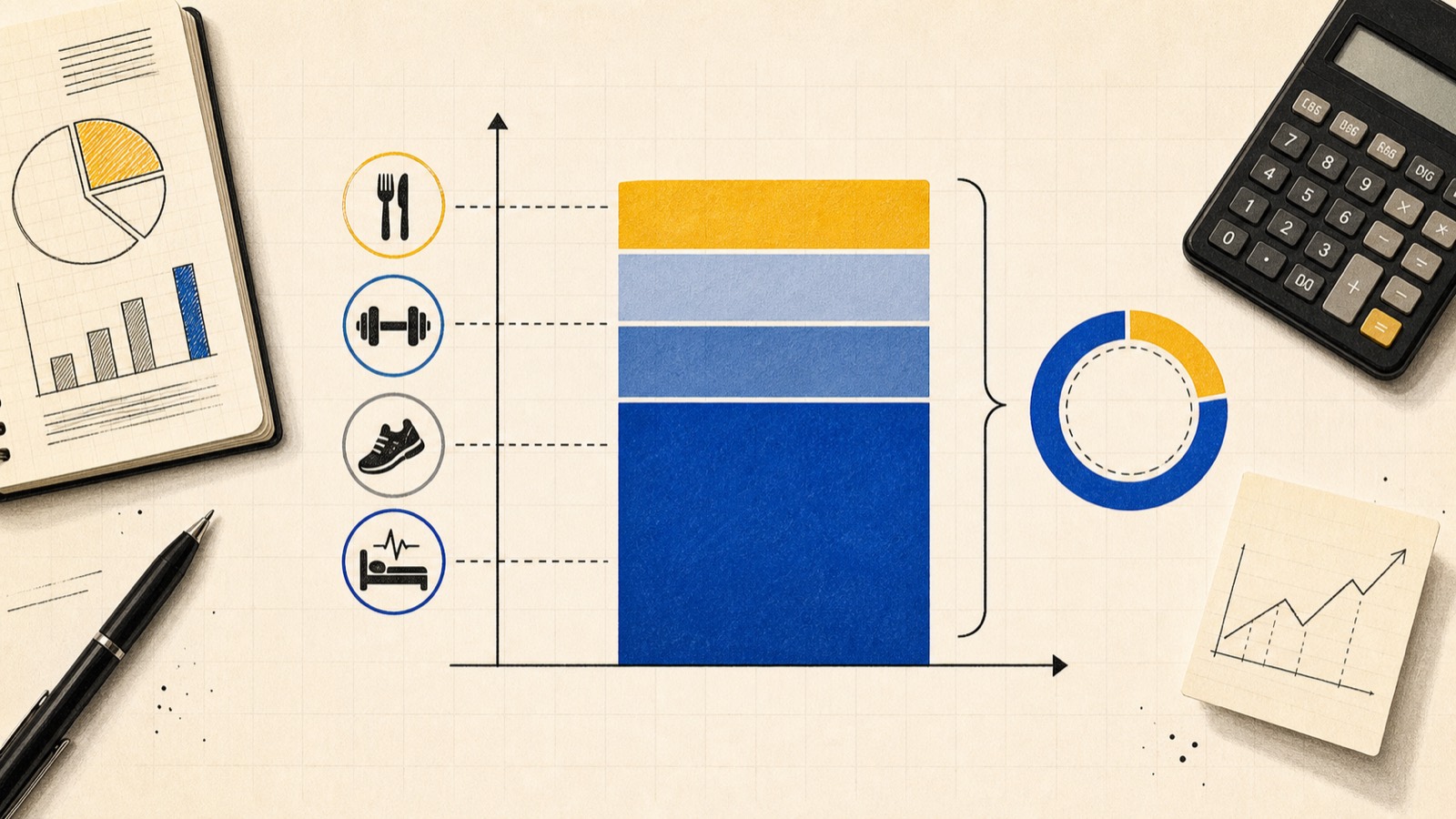
Plug your details into the macro calculator and you get back two numbers most people skim past: BMR and TDEE. Knowing what each one means is the difference between using the tool well and anchoring to the wrong number for months.
BMR: what your body costs to keep the lights on
BMR stands for basal metabolic rate. It's the energy cost of being alive and doing nothing else. If you lay in bed for 24 hours, didn't move, didn't eat, and stayed at a comfortable temperature, you would still spend this many calories running your heart, lungs, kidneys, liver, and brain.
Most adults' BMR lands somewhere between about 1,400 and 1,900 calories per day. Larger bodies cost more. Younger bodies cost a little more. More muscular bodies cost a little more. The estimating equation most calculators (including this one) use is Mifflin-St Jeor (1990), which uses sex, age, height, and weight and is generally accurate within roughly 10% for healthy adults.
Important: BMR is a floor, not a target. Eating at or below BMR for long stretches sends a clear signal to the body that energy is scarce, and hormonal and behavioral adjustments follow. BMR is a useful reference number. It isn't where you should live.
TDEE: what your day actually costs
TDEE stands for total daily energy expenditure. It's BMR plus everything else, including planned workouts, the thousand small movements you make outside of formal exercise, and the energy cost of digesting food.
TDEE has four main components (NIH Endotext, Trexler et al., 2014):
- BMR: the baseline cost of existing.
- EAT (exercise activity thermogenesis): calories burned during planned workouts.
- NEAT (non-exercise activity thermogenesis): walking, fidgeting, standing, errands, climbing stairs.
- TEF (thermic effect of food): calories spent digesting and processing what you eat.
Most people overestimate EAT and underestimate NEAT. A 90-minute weights session burns roughly 300 to 500 calories for most adults. A job that keeps you on your feet eight hours can burn far more than that, every day.
BMR is the engine idling. TDEE is the engine running. You eat for the engine running, not the dashboard lights.
Which number to anchor to
For nutrition planning, TDEE is the number that matters. Specifically:
- Eating at TDEE means maintenance: bodyweight roughly stable across weeks.
- Eating below TDEE means a deficit: weight goes down. The size of the deficit sets the pace.
- Eating above TDEE means a surplus: weight goes up, ideally as muscle if you're training, otherwise as fat.
BMR is not a normal planning target. Extended very-low-calorie dieting should be supervised, especially for active adults. TDEE tells you where you actually plan from.
Calculator output is a hypothesis, not a verdict
Every prediction equation is an estimate. Mifflin-St Jeor is accurate to within roughly 10% for most healthy adults. Your actual TDEE could be 200 to 300 calories above or below the calculator's first guess.
Treat the calculator's number as a starting hypothesis. Eat at the estimated maintenance for two weeks. Weigh yourself in the morning, a few mornings a week, and average those readings. If the weekly average is going up, your real TDEE is lower than the estimate. Pull calories down. If it's drifting down when you wanted maintenance, your real TDEE is higher than the estimate. Eat a little more.
Two adjustments in, you'll usually be within about 100 calories of your actual maintenance. That number is more useful than any prediction equation.
Try the hybrid athlete macro calculator to get a Mifflin-St Jeor BMR + TDEE estimate plus per-day macros for rest, easy, and hard training days.
The activity multiplier is where most people lie to themselves
The biggest source of error in any TDEE estimate is the activity multiplier you select. Most people pick the level above their actual life. "I go to the gym four days a week" sounds like Moderately Active until you account for the 9 hours at a desk and 80 minutes on the couch each evening.
Be honest. When in doubt, pick the lower of the two options you're considering. Underestimating TDEE costs you a week. Overestimating it costs you a month of wondering why you're not losing weight.
The simple version
BMR is the cost of staying alive. TDEE is the cost of being you. Plan around TDEE. Don't eat under BMR for long. Use the calculator as a starting point, and let two weeks of real-world data refine the number.
For information and education, not medical advice. If you have a health condition, are pregnant, or take medication that interacts with diet, talk to a clinician before making changes.
End of note
Subscribe
Get the next Field Note by email
A short email when a new article or recipe ships. No spam, no upsell, unsubscribe in one click.