
How Much Protein Do You Really Need?
The RDA was set to prevent deficiency, not to fuel training. Here's where the protein research sits for people who lift, and how to actually hit a useful target.
 By Matt McCabeApril 7, 20267 min read/ Foundations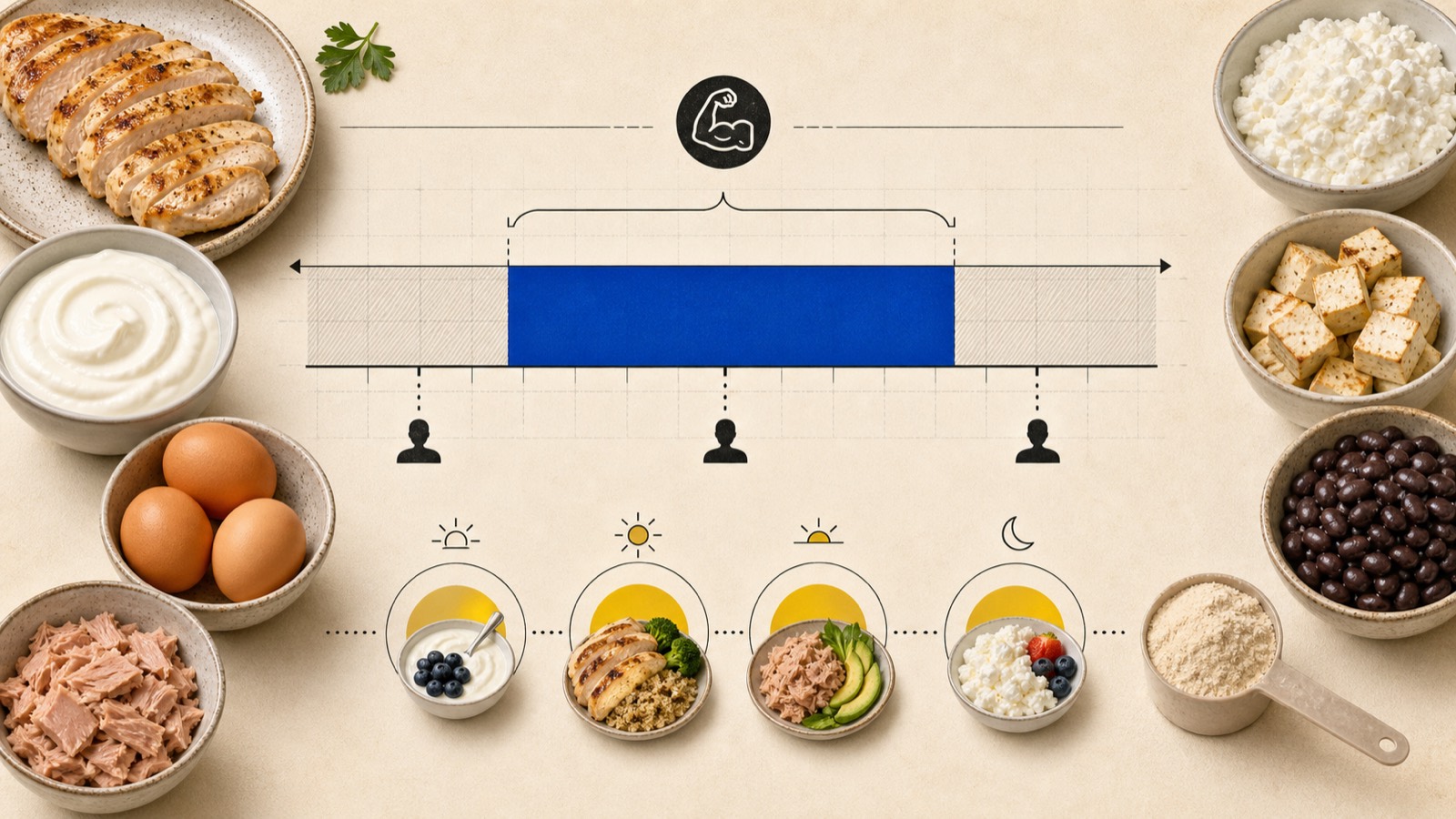
Open any government nutrition page and you'll see the same number: 0.8 grams of protein per kilogram of bodyweight per day. That's the Recommended Dietary Allowance. It was set decades ago to prevent nitrogen deficiency in sedentary adults (Institute of Medicine, 2005). It works for that purpose.
For trained adults, the RDA answers the wrong question. It prevents deficiency. It doesn't optimize training adaptation. The research on people who lift and on athletes pretty consistently lands on a higher useful range.
Where the research actually lands
Two strong reference points:
- The 2018 Morton et al. meta-analysis pooled 49 studies and 1,863 participants and found benefits of higher protein intake on lean mass and strength up to about 1.62 g per kg per day (roughly 0.74 g per pound), with additional benefits trailing off beyond that.
- The 2017 ISSN protein position stand summarized the literature and concluded that for resistance-training adults, daily intakes of 1.4 to 2.0 g per kg per day (about 0.6 to 0.9 g per pound) are appropriate, with higher amounts potentially useful during energy restriction.
Translating: for a 175-pound adult who lifts, somewhere in the range of 120 to 180 g of protein per day is a reasonable target. That's a long way above the RDA's ~63 g for the same person, and it's achievable with normal food.
Two common myths worth retiring
"Excess protein damages your kidneys." The studies that worry doctors most about protein and kidneys come from people with pre-existing kidney disease, where protein restriction is appropriate. A 2018 meta-analysis (Devries et al., Journal of Nutrition) found no evidence that higher protein intakes harm kidney function in adults with healthy kidneys.
"Your body can only absorb 30g at a time." Your gut absorbs essentially what you eat. The 30g figure comes from work on per-meal muscle protein synthesis, which is a different question than absorption. Eating more than ~30g in one meal isn't wasted; it just means a slightly smaller share is going directly into new muscle protein synthesis. Total daily intake matters more than any single meal.
The RDA prevents deficiency. The training number supports adaptation. You're not asking the same question.
Spread tends to help
Within the same daily total, splitting protein across several meals usually produces a slightly better lean-mass result than two large meals. The Schoenfeld and Aragon review (2018) walks through the evidence and lands at a practical recommendation of 3 to 5 meals of about 0.4 to 0.55 g per kg of bodyweight each. For a 175-pound person, that's roughly 30 to 45g of protein, three to four times a day.
This is a refinement, not a requirement. Hitting the daily total at all is the bigger move. Spreading the meals is a small additional win.
Foods that make hitting the number realistic
Approximate values per common serving (USDA FoodData Central):
- 6 oz cooked chicken breast: about 50g protein
- 6 oz cooked 93/7 ground beef: about 40g
- 1 cup nonfat Greek yogurt: about 22g
- 4 large eggs plus 4 egg whites: about 30g
- 1 scoop whey isolate: about 25g
- 1 can light tuna in water: about 30g
- 1 cup low-fat cottage cheese: about 25g
- 6 oz lean turkey deli meat: about 30g
Three of those across a day usually puts you near 100g without thinking about it. Add a fourth and most adults are at or above their target.
Want your number worked out for you? The hybrid athlete macro calculator sets protein from bodyweight in pounds, so the floor scales with your size rather than getting lost as a percentage of total calories.
"I can't eat that much"
Three common patterns when people say they can't hit protein:
- Breakfast is a carb meal. Adding eggs, Greek yogurt, or cottage cheese to breakfast tends to fix half the gap.
- Carbs come first. A bagel before the chicken means the chicken doesn't get fully eaten. Reverse the order on the plate.
- The protein doesn't sound good. Variety matters. If you don't like chicken, eat fish. If yogurt is unpleasant, try shakes. The body doesn't care which form shows up.
The move
For most trained adults, somewhere around 1.6 to 2.2 g of protein per kg of bodyweight, spread across 3 to 5 meals, from a mix of foods you'll actually eat. Don't sweat hitting it every day; track the weekly average. That habit changes body composition more reliably than almost anything else in nutrition.
Use the calculator to get a starting target based on your weight and goal.
For information and education, not medical advice. If you have a health condition, are pregnant, or take medication that interacts with diet, talk to a clinician before making changes.
End of note
Subscribe
Get the next Field Note by email
A short email when a new article or recipe ships. No spam, no upsell, unsubscribe in one click.