
Meal Prep Math: Turning Macros Into Actual Meals
Hitting macros across the week is easier as a budget than as a per-meal calculation. Here's how to set it up.
 By Matt McCabeFebruary 10, 20267 min read/ Meal Prep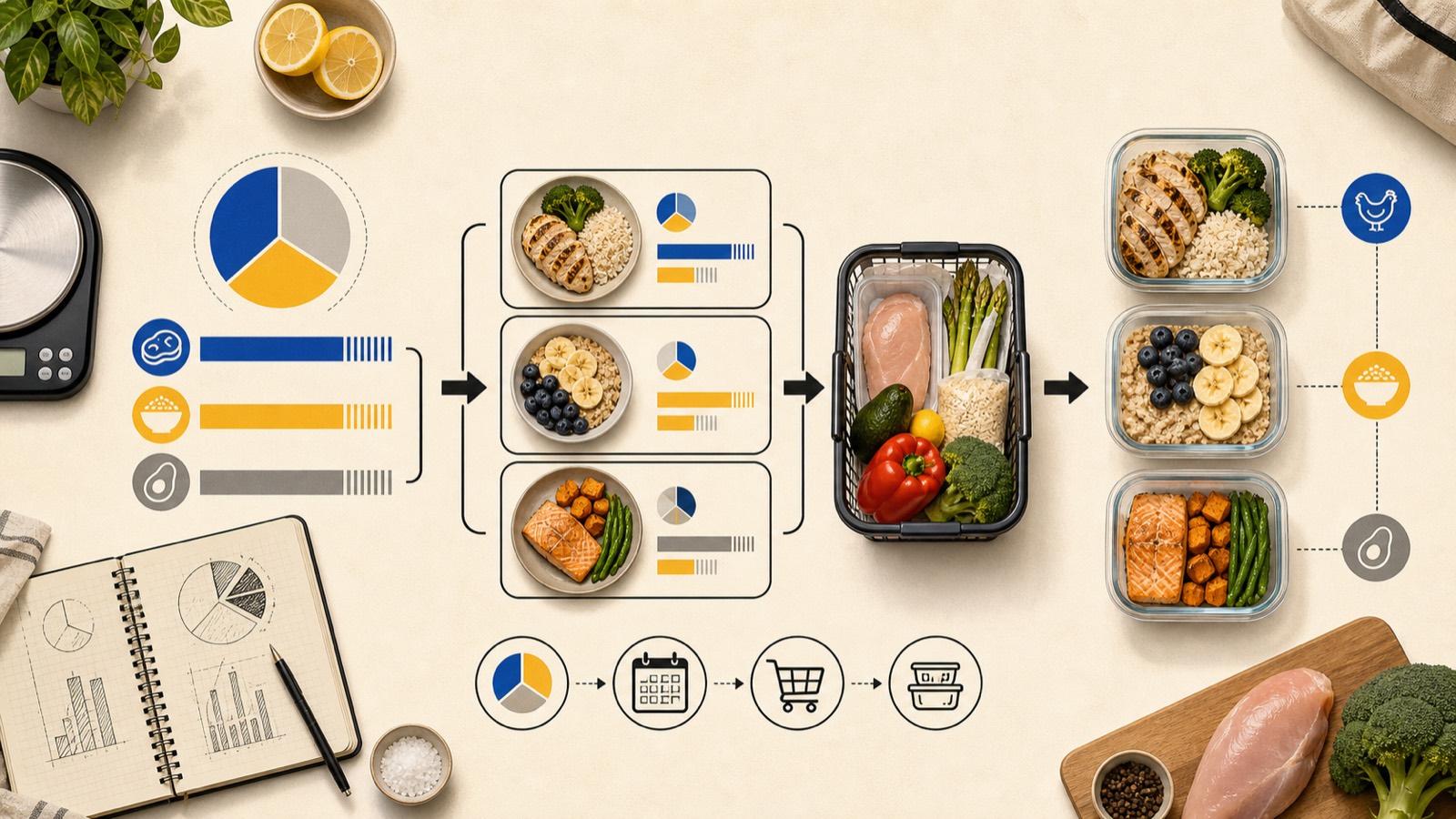
Hitting macros across a week is a budget problem. Most people try to solve it one meal at a time, in the moment of eating. That's the worst time to do math: tired, hungry, distracted, with a phone showing a list of grams you're supposed to compose into food.
The cleaner approach is to solve the math before the week starts. You're not deciding what to eat in the moment. You're following a plan you made when your brain was working. Here's how that math usually goes.
Step 1: lock the daily protein target
Use the macro calculator for a starting target. For most active adults, that's somewhere between 140 and 220g per day. Pick a round number you can hit consistently and call it your protein floor.
From here on, this number is the anchor. Every meal-prep decision works backward from it.
Step 2: divide protein across 3 to 4 meals
If your target is 180g, divide it: roughly 4 meals at 45g, or 3 meals at 50g plus a 30g snack. Now each meal has a known protein job.
This pattern lines up with the protein-distribution research: Schoenfeld and Aragon (2018) recommend roughly 0.4 to 0.55g per kg of bodyweight at each of 3 to 5 meals across the day to optimize muscle protein synthesis. For a 175-pound person, that's about 30 to 45g of protein, 3 to 4 times a day. Useful confirmation, but more importantly: workable.
Step 3: spend the rest of the calorie budget on carbs and fat
Say your daily target is 2,400 kcal. Protein at 180g = 720 kcal. That leaves 1,680 kcal for carbs and fat.
For a balanced split: about 50% from carbs and 25% from fat. That works out to roughly 210g of carbs (840 kcal) and 47g of fat (~420 kcal). The calculator gives you a split per goal; round and adjust as needed.
Now your daily plate budget is something like 180p / 210c / 47f. Every meal is allocating slices of that budget.
Macros are a budget. Plan the spend before you sit down to spend it. You wouldn't negotiate rent every time you opened the fridge.
Step 4: write meals on paper, by macros
Before going to the grocery store, lay out a sample day:
- Breakfast: 4 eggs + 4 whites + 1 cup oats + 1 banana + 1 tbsp peanut butter ≈ 38p / 55c / 22f
- Lunch: 6 oz chicken + 1.5 cups rice + 1 cup vegetables + 1 tbsp olive oil ≈ 50p / 65c / 14f
- Snack: 1 cup Greek yogurt + 1 scoop protein + berries ≈ 45p / 25c / 1f
- Dinner: 6 oz salmon + 1.5 cups rice + 2 cups vegetables + lemon ≈ 42p / 65c / 14f
- Daily total: ~175p / 210c / 51f ≈ 2,400 kcal (round portions to land within ~10% of target)
Tweak portions to land near your numbers. The point isn't day-one perfection. The point is having a written plan that lands within roughly 10% of your target. After two days of cooking from it, you'll know what to adjust.
Step 5: turn the meals into a shopping list
Multiply up. If you need 6 oz of chicken at lunch each day, that's 42 oz (~2.6 lbs) of chicken for the week. If breakfast uses 6 eggs and 4 whites daily, that's 42 eggs and a carton of whites. Round up; over-prep is cheaper than under-prep.
Your shopping list isn't a guess anymore. It's derived from your math. Walk into the store, buy the math, walk out.
Step 6: cook the math on Sunday, assemble it during the week
Cook the proteins in bulk. Cook the carb base in bulk. Roast the vegetables in bulk. Each weekday meal is a 5-minute assembly. The macros are decided for you because the budget is already set.
For more on the assembly side, see the Tuesday meal-prep system.
Macro shorthand worth memorizing
Approximate values per cooked serving (USDA FoodData Central):
- 4 oz cooked chicken breast: about 35p / 0c / 4f
- 4 oz cooked lean ground beef (93/7): about 28p / 0c / 12f
- 1 cup cooked rice: about 4p / 45c / 0f
- 1 medium sweet potato: about 2p / 25c / 0f
- 1 large egg: about 6p / 0c / 5f
- 1 cup non-fat Greek yogurt: about 22p / 10c / 0f
- 1 scoop whey isolate: about 25p / 2c / 1f
- 1 tbsp olive oil: about 0p / 0c / 14f
Memorize those eight and you can build a meal in your head before walking into the kitchen.
The simple version
Meal-prep math isn't hard. It's just a different muscle from the one most people use. Plan the spend on Sunday. Cook the inputs. Assemble through the week. Don't do the math at the moment of eating.
Race weeks are the exception. If you have an endurance event over 90 minutes on the calendar, the normal weekly budget gets overridden for the 48 hours before the race in favor of a higher-carb, lower-fiber load. The endurance carb-loading calculator handles that pre-race plan; the everyday version is the one above.
If you'd rather not do the math at all, Mero handles this kind of weekly allocation automatically against a training calendar.
For information and education, not medical advice. If you have a health condition, are pregnant, or take medication that interacts with diet, talk to a clinician before making changes.
End of note
Subscribe
Get the next Field Note by email
A short email when a new article or recipe ships. No spam, no upsell, unsubscribe in one click.