
Why Your Weight Loss Stalled (Even Though You're Tracking)
Most stalls have a small set of usual suspects. Seven things to check, in the order that catches the most of them.
 By Matt McCabeMarch 24, 20268 min read/ Programming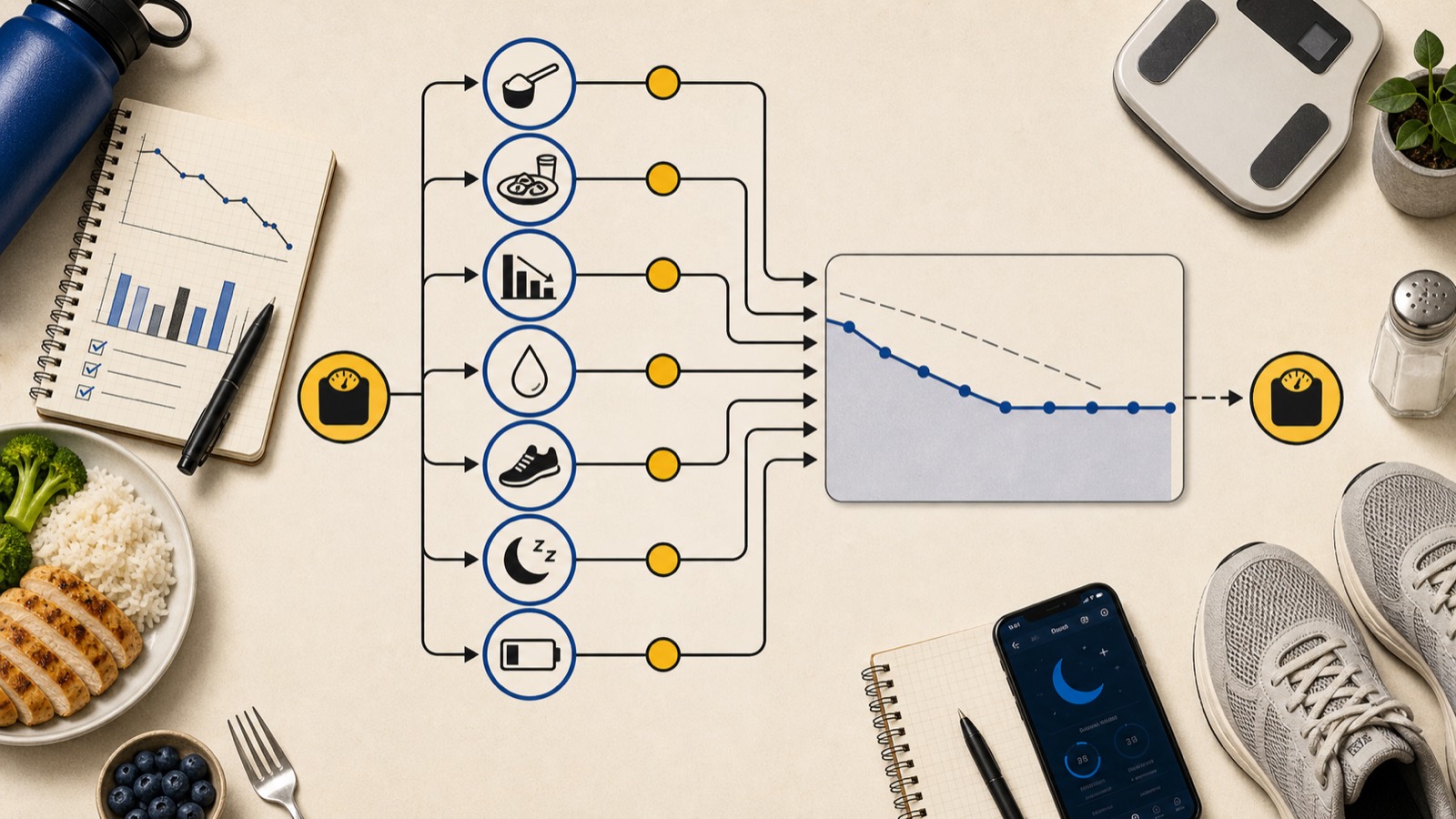
You've been tracking. The numbers look right. The food is going in, the workouts are happening, the protein is hitting. And the scale hasn't moved in three weeks. Or worse, it's gone up. This is one of the most discouraging spots in a fat-loss process, and one of the more fixable.
A stall is usually a small set of usual suspects. Work through them in this order. Start with the first three because they catch the most common errors in practice.
1. You're not actually eating what you think you're eating
This is the most common cause by a wide margin. Self-reported intake tends to be off by 20 to 40% in carefully studied populations (Lichtman et al., NEJM, 1992 is the classic; the result has been replicated many times since). The usual gaps:
- Estimating portions instead of weighing them.
- Skipping coffee creamer, cooking oil, sauces, handfuls of nuts.
- Eyeballing peanut butter (a tablespoon is about 16g; most "tablespoons" come out closer to 30 to 40g).
- Not logging weekend meals because "they don't count."
The fix: weigh and log everything you eat or drink for three days, cooking oils and creamer included. Almost everyone uncovers an extra 300 to 500 calories that weren't being tracked. Once you see them, you can decide what to keep eating. The data is the point.
2. Your weekly total is much higher than your daily total
Five 1,800-calorie days plus two 3,200-calorie days isn't a 1,800-calorie diet. It's about a 2,200-calorie diet. The math doesn't care which day of the week the food showed up.
Track for a full week, weekends included, and look at the weekly average. If it's well above where you thought you were, the stall isn't a stall. The deficit just doesn't exist.
3. Your maintenance dropped as you lost weight
Lose 10 to 15 pounds and your TDEE drops too, since you're carrying less mass around all day. Some of this is simple physics; some is documented metabolic adaptation beyond what bodyweight alone would predict (Trexler et al., 2014; Fothergill et al., 2016).
Re-run the calculator with your current weight. Drop calories by 100 to 200 to restore a real deficit. You may need to do this again every couple of months during a longer cut.
The scale isn't broken. The plan is stale. Diets need maintenance the same way training does.
4. You're holding water for one of fifteen reasons
Daily weight is mostly water and gut contents. Stress, sleep, sodium, hormonal cycles, hard workouts, and a large meal the night before can swing the scale 2 to 4 pounds with no impact on actual fat loss.
Weigh yourself daily if you want, but ignore the daily reading. Take the weekly average. If the weekly average is drifting down, you're losing fat, regardless of what a single morning said.
5. Your NEAT has quietly fallen off
Non-exercise activity (walking, fidgeting, standing) tends to drop in a deficit. The change isn't conscious. Over weeks, it can wipe out 200 to 400 calories of daily burn (Levine, 2007).
Set a daily step count and hit it. Anywhere from 7,000 to 12,000 works for most adults. Don't let activity quietly evaporate while the diet is trying to do the work.
6. You're not sleeping enough
Short sleep raises appetite hormones, lowers willingness to train hard, and shifts body composition slightly toward fat retention in controlled studies (Nedeltcheva et al., 2010; St-Onge, 2017). A week of 5-hour nights can effectively erase a 300-calorie deficit through higher intake and lower daytime burn.
Protect 7+ hours when you can. Stalls often clear within a week once sleep comes back.
7. The diet has been too aggressive for too long
After 12+ weeks in a continuous deficit, hormones and recovery are usually suppressed and NEAT is reliably down. The deficit on paper isn't producing the deficit you'd expect.
A diet break works for this. Eat at maintenance for 1 to 2 weeks (fully, not as a binge), then resume. The MATADOR trial (Byrne et al., 2018) found that intermittent diet breaks improved total fat loss vs. continuous restriction over 16 weeks of intervention, likely by limiting metabolic adaptation and improving adherence.
The diagnostic order, in one place
- Weigh and re-log everything for 3 days. If you find 300+ uncounted calories, fix it.
- Check the full weekly average, weekends included. If it's higher than you thought, fix it.
- Re-run the calculator with current weight. If TDEE has dropped, adjust calories.
- Switch to weekly-average scale tracking. If the average is moving, keep going.
- Audit step count. If it's dropped, restore it.
- Audit sleep. If under 6.5 hours, address that before tightening calories further.
- Take a 1 to 2 week diet break. Resume.
The simple version
A stall is information, not a verdict. It's telling you something specific about intake, tracking, training, or recovery. Work the list in order. The fix is in the first three for most people.
For information and education, not medical advice. If you have a health condition, are pregnant, or take medication that interacts with diet, talk to a clinician before making changes.
End of note
Subscribe
Get the next Field Note by email
A short email when a new article or recipe ships. No spam, no upsell, unsubscribe in one click.